Liquidation, outlet or regular store: what's the difference?
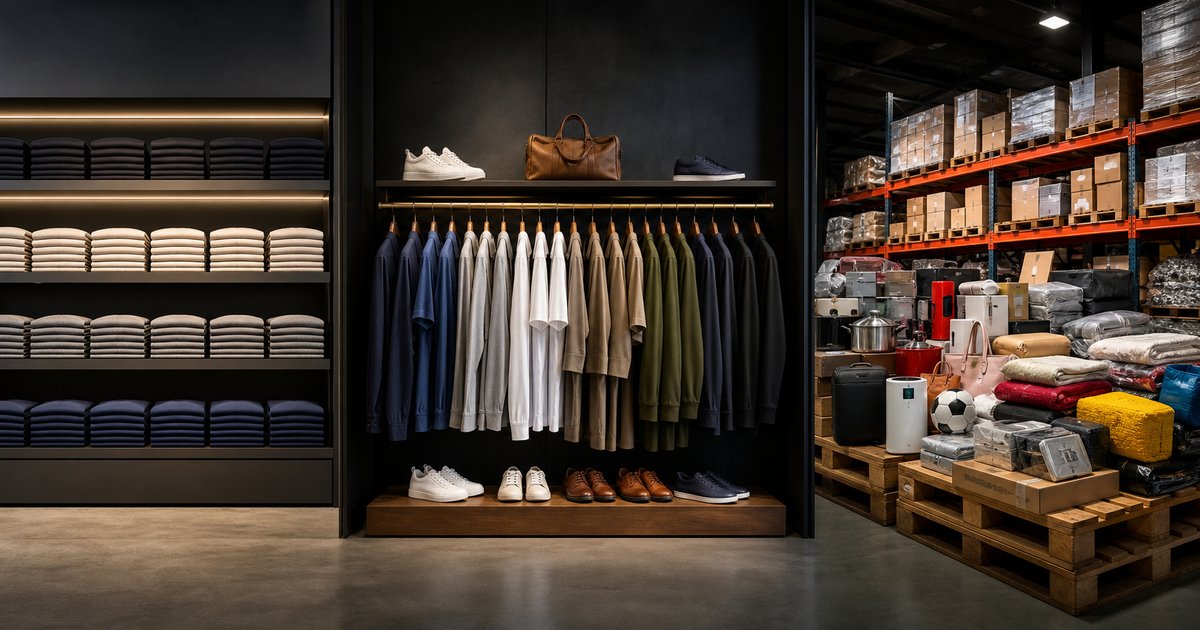
The words "liquidation", "outlet" and "sale" are often used as if they meant the same thing. Yet they describe different business realities. The common thread is obvious: the customer hopes to pay less. What changes is where the merchandise comes from, how stable the inventory is, and how prices get set.
The regular store: a planned assortment
A traditional retailer builds its inventory in advance. It chooses its collections, sizes, colors and quantities, and can often reorder a product that sells well. This planning lets customers find a relatively stable selection from one visit to the next — but not necessarily the lowest price.
The outlet: a brand's world at a discount
An outlet is usually tied to a brand or group of brands. You can find previous collections or overstock meant for that sales channel there. The advantage for customers is shopping within a familiar world — the cuts and style remain useful reference points. But a crossed-out price tag isn't proof enough of savings: the discount always needs to be assessed against the actual product.
Liquidation: lots that change the experience
A liquidation store is built around sourcing opportunities: retailer overstock, unsold items, closeouts or clearance sales. It doesn't necessarily order a full collection in every size, which is why inventory can change quickly from one visit to the next. A great find might not be replaced once that lot sells out.
At Surplus Liquidation, the message is deliberately clear: discounts can reach 75% on a selection, and inventory depends on arrivals. That doesn't mean every item is 75% off, or that a specific product will always be available.
A concrete example: the same need, three paths
Imagine someone looking for a simple coat for everyday commuting. At a regular store, they can compare several sizes of the same model and ask for a different color. At an outlet, they explore a particular brand's collections, sometimes with a less complete selection. At a liquidation store, they might come across several models from different lots, with no guarantee of finding the same cut later.
The best path depends on the priority: the stability of a regular store if the coat needs to be bought today with specific criteria, the outlet if the brand matters a lot, or liquidation if you're willing to compare different options and come back another time.
Which model to choose based on your need
Choose a regular store if your priority is an exact reference or a full selection. Visit an outlet if you're mainly after a particular brand's world. Explore liquidation if you're flexible and ready to compare one-off arrivals. Nothing stops you from combining all three depending on the moment's need.
Frequently asked questions
Does an outlet always sell products straight from a factory?
Not necessarily. The model and sourcing of products vary by company — always check the information provided for the item in question.
Is a liquidation product necessarily used?
No. Liquidation describes a way of moving stock, not the product's condition. Always examine the item and its packaging.
Why doesn't an item come back in stock?
Liquidators often buy limited lots. Once a lot sells out, identical restocking isn't guaranteed.
Where can I visit Surplus Liquidation?
At 7945 Provencher Blvd in Saint-Léonard, Montreal, Monday to Saturday, 10 AM to 5 PM.